Soil Probe Selection Hub

3 in 1 Soil Moisture Sensor

Soil Probe Selection Hub

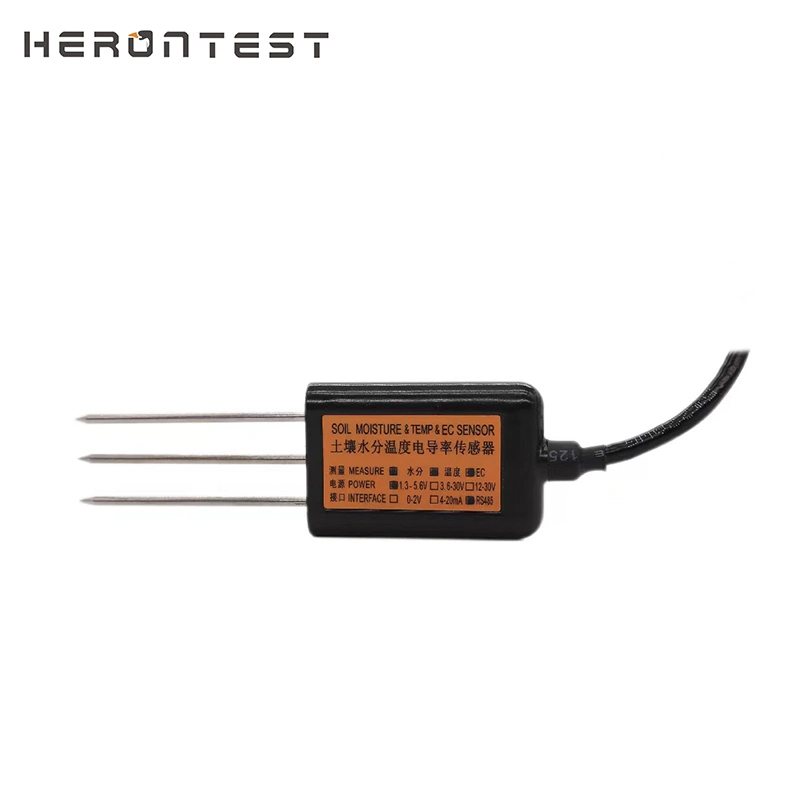
Choosing a probe starts with the medium it will live in. This guide reads the HNT-MEC10 3 in 1 soil moisture sensor against the three ways sites actually run — long-term burial in a soil profile, continuous submersion, and fertilizer or nutrient solution matrices — and shows how a precision agriculture soil sensor slots into loggers, data acquisition and automation. Every point below traces back to the published product details: dielectric-constant moisture sensing, EC and temperature in one body, alloy electrodes, and a fully sealed housing.

3 In 1 Soil Moisture & Temperature & EC sensor

The Model in One Screen: HNT-MEC10

What the product page states, and what each line means when you are preparing an inquiry.

Model / part number HNT-MEC10
Parameters measured Soil moisture content, electrical conductivity (EC) and temperature — three readings from one device
Moisture principle Dielectric constant of the soil reaction; the page notes this method is in line with international standards at present
Electrode material Specially treated alloy, resistant to acid and alkali corrosion and to mechanical impact
Housing Completely sealed — suitable for burial in soil or direct immersion in water
Output Multiple protected signal output interfaces; specific interface types confirmed at quote
Deployment modes Buried in soil or submerged in water for long-term dynamic testing; also used for fertilizer and other nutrient solution conductivity matrices
Customization OEM and ODM customization offered through inquiry

Read the table as three buying decisions

One body, three readings Moisture, EC and temperature arrive from a single installation point, so the site plan needs one probe position, one cable route and one record.
Sealing is built in, not added on Because the housing is completely sealed, buried and submerged operation is a fit question rather than an extra specification you have to negotiate.
Interfaces are settled at quote stage The page promises multiple protected signal output interfaces without naming them — so bring your logger, data acquisition or controller details to the inquiry.
OEM and ODM paths exist If the standard probe body does not match your enclosure, marking or packaging plan, raise the requirement before pricing is fixed.

What Each of the Three Parameters Actually Decides

Three readings, three different control questions. Knowing which one drives your project keeps the inquiry short.

Soil moisture

The probe works from the dielectric constant of the soil reaction and derives real moisture content from it — the product page states this method is in line with international standards at present.

Use it to decide When to start and stop irrigation, and how much water the root zone is actually holding.
Electrical conductivity

EC describes how conductive the solution around the probe is. The product page positions the probe for fertilizer and other nutrient solution conductivity matrices, so the reading belongs to that liquid, not just to soil.

Use it to decide Whether nutrient strength is drifting, and when a fertigation batch needs correcting.

Temperature

Temperature is measured inside the same body as moisture and EC, so each reading set carries the thermal context of the same point in the profile instead of a nearby air sensor.

Use it to decide Whether two moisture or EC readings are being compared under similar conditions.

Deployment Mode Matrix: Soil, Water or Nutrient Solution

The medium decides the mounting, the service routine and the questions worth asking before you order.

Buried in soil

The sealed housing is designed for long-term burial, and the probe insert design keeps stable contact with the surrounding soil so readings reflect the profile rather than the air gap around the body.

Verify before quoting
  • Insertion depth and access for re-checks
  • Soil contact around the probe body
  • How the cable is protected at the soil surface
Talk through your soil profile →

Submerged in water

The product page states the probe can be directly immersed in water for long-term dynamic testing. Reservoir, tank and channel monitoring is therefore a supported mode rather than a workaround.

Verify before quoting
  • How the probe is fixed in the water column
  • Which tank, reservoir or channel the reading represents
  • How the probe is retrieved for cleaning
Plan a submersible installation →

Fertilizer & nutrient solution

The same probe is listed for fertilizer and other nutrient solution conductivity matrices, so EC can sit alongside moisture and temperature in one record instead of a separate handheld check.

Verify before quoting
  • Solution strength and mixing cycle
  • Whether EC drives a dosing controller
  • The cleaning routine between batches
Discuss your fertigation loop →

Match Your Site to What You Specify

Start from the site, not the datasheet. Each scenario below points to the configuration question that actually changes the quote.

Open-field and orchard blocks

A probe that stays in the ground for the season needs a body that survives burial and electrodes that tolerate the local soil chemistry.

Specify Buried deployment with moisture and temperature from the same point. Confirm at quote Profile depth, the cable route to the logger, and the inspection cycle.

Greenhouse and soilless fertigation

Where irrigation and nutrient dosing run together, one probe covering moisture, EC and temperature removes a second instrument from the bench.

Specify Nutrient solution conductivity plus moisture and temperature, in one body. Confirm at quote Which solution matrix is measured, and whether EC feeds a dosing controller.

Saline, sodic or reclaimed land

Salt load and fertilizer residue are what shorten probe life. The specially treated alloy electrodes are the part of the specification to argue over here.

Specify Alloy electrodes rated against acid and alkali corrosion in the product description. Confirm at quote Expected salinity exposure and whether a spare probe should be stocked for rotation.

OEM and ODM builds

If the probe becomes part of your own system, the conversation moves from a single unit to a repeatable configuration.

Specify Protected signal output interfaces plus OEM or ODM customization. Confirm at quote Enclosure, marking, packaging and the interface type you are wiring into.
Close view of the HNT-MEC10 soil moisture, EC and temperature probe showing the alloy electrode body and sealed housing Sealed housing Alloy electrodes

Durability: What Survives a Season in the Ground

Specially treated alloy electrodes Described as resistant to acid and alkali corrosion as well as mechanical impact — the specification that matters where salinity or fertilizer load would attack a standard electrode pair.
Completely sealed housing Sealing is part of the body design, which is why the same probe can be buried in soil or immersed directly in water for long-term dynamic testing.
Impact-resistant construction The body is built to cope with mechanical damage in working soil. Plan an inspection cycle anyway — a probe that is checked is a probe whose readings stay trustworthy.
High precision and fast response The probe insert design keeps stable contact with the soil, so readings stay consistent across variable soil types instead of drifting with the gap around the body.

Integration and Signal Fit

The probe only earns its place once the signal reaches the system that acts on it.

HNT-MEC10 probe moisture · EC · temperature
Protected signal output interfaces perfect protection circuit
Data acquisition systems
Loggers
Agricultural automation

What the product page commits to

A perfect protection circuit and a range of signal output interfaces intended for data acquisition systems, loggers and agricultural automation. The page does not name protocols, voltage or connector types, so those details are settled per project.

What to bring to the inquiry

Name the endpoint first — a logger, a data acquisition unit or an automation controller — then describe the run between probe and cabinet. Interface options are confirmed at quote, and OEM or ODM customization is available when a standard build does not fit.

Send your interface requirement →

Pre-Quote Selection Checklist

Answer these eight questions before you request pricing — they are the same ones a technical quote has to resolve.

  1. MediumIs the probe going into soil, into water, or into a fertilizer and nutrient solution matrix?
  2. DeploymentWill it be buried long term, submerged, or both across different sites?
  3. Cable runHow far is the probe from the readout, and how is the cable protected along the way?
  4. EndpointWhich logger, data acquisition system or automation controller receives the signal?
  5. Use of dataDo the readings drive irrigation, fertigation dosing, or trend records?
  6. ExposureWhat salinity, fertilizer concentration or chemical load should the electrodes expect?
  7. CustomizationDo you need OEM or ODM changes to the body, marking or packaging?
  8. Service routineWho cleans and inspects the probe, and how often does that happen?

Ready to Quote the Right Configuration?

Send the medium, the deployment mode, the cable run and the system you are wiring into. We will come back with a configuration for the HNT-MEC10 — including the signal output interfaces that suit your setup, and OEM or ODM options where the standard build is not the right fit.

Related Reading

Three notes to help clarify product requirements before contacting the supplier.

What Do 3-in-1 Soil Moisture, Temperature, and EC Sensors Measure?

A 3-in-1 soil sensor combines volumetric water content, soil temperature, and electrical conductivity in one probe so every reading describes the same soil sample at the same moment.

Read article

Selecting Corrosion-Resistant Soil Probes for Saline Land Monitoring

Saline-land monitoring requires a probe that can keep producing comparable soil EC, moisture, and temperature readings through wetting, drying, salt accumulation, and waterlogged periods, so…

Read article

3-in-1 Soil Sensors for Greenhouse Fertigation Control

Greenhouse fertigation works best when moisture, temperature, and EC come from the same root-zone sample, not from separate probes installed at different times.

Read article

Frequently Asked Questions

what information is shown for this product?

review the product details, images, and specifications presented on the official product page.

where can i check the intended application?

use the application and use-case information published on the official product page.

which specifications should i confirm before ordering?

confirm the specifications and options listed for the exact product variant before placing an order.

where can i check available options?

check the official product page or ask the supplier about options shown for the selected product.

how can i request product information?

use the official contact or inquiry path provided on the site.

what should i include in an inquiry?

include the product page, intended use, required quantity, and any specifications you need the supplier to review.

How to place an order?

You can place order through:

1. Send us your request directly from the website.
2. Send us an inquiry to our email.
3. Give us a call.

How to pay your order?

We mainly use T/T bank transfer, also we paypal, western union, credit card. Once we confirm your order, we will send you the payment detail at the quotation.

What is the ETA?

Usually you can receive the package in 7days after we receive your payment. For the electrical equipment and machine, will need longer time, depends on the transportation method (Sea shipping will need about 30days, airway will need about 7-14days).

Is the product you sell have certificate?

All the product we sell are meet the relavent international standard requirement. If you need a third party certificate, please tell us, and we can send the product to ISO calibration facility (issue the certificate will need extra cost.)

What are the shipping methods?

For the normal package, we mainly use DHL, FEDEX, UPS. The delivery time is fast and package usually get well secured.
 
For the big size package, we use AIR WAY, SEA WAY and RAILWAY. The delivery time will be around 2-4 weeks. 

How long is the warranty?

All the products we sell share 1 year warranty, some particular products may have longer period.

Where do we manufacture our product?

All the products we sell are manufactured at China.

Do you have customized service?

We provide OEM and ODM service, please contact us if you need customized product.

What is the language for the equipment?

For the equipment and machine we sell, usually they will have 2 languages: english and chinise.

For the description paper, they will come in english language.